

- Boating Accident Resources
- Car Accident Resources
- Commercial Vehicle Accident Resources
- Construction Accident Resources
- Consumer Protection Resources
- Dog Bite Resources
- Firm News
- Motorcycle Accident Resources
- Personal Injury Resources
- Premises Liability Resources
- Product Liability/Mass Tort Resources
- Referral Resources
- Rideshare Accident Resources
- Slip and Fall Resources
- Truck Accident Resources
- Worker's Compensation Resources
- Wrongful Death Resources
- FAQs Floridians Ask About the FCCPA
- The Real Deal
- The Federal Law: What the FDCPA Does
- The Hole in the Federal Law That Florida Fixed
- What the FCCPA Adds
- The Two-Year Statute of Limitations
- The 19 Things a Collector Can’t Do in Florida
- Damages Under the FCCPA
- Florida Also Requires Debt Collectors to Be Licensed
- How the Two Laws Work Together
- Ready To Stop the Harassment?
FAQs Floridians Ask About the FCCPA
Yes. The FCCPA doesn’t care whether the underlying debt is legitimate. It cares about how the collector behaved while trying to collect. You can owe every penny they say you owe and still have a case if the way they tried to collect violated the statute.
Yes. Consumer debt under the FCCPA includes debt incurred for personal, family, or household purposes. Medical bills generally qualify. So do utility bills, credit card debt, auto loan debt, mortgage debt, and most other types of consumer obligation.
Technically, yes, but you almost certainly shouldn’t. FCCPA cases are technical, and the rules around damages, evidence, and procedure are not the kind of thing most people want to handle alone.
The defendants are usually represented by experienced defense attorneys whose entire job is fighting these cases. The good news is that under both the FDCPA and the FCCPA, the defendant pays your attorney’s fees if you win. There’s no out-of-pocket cost to you.
- Call logs
- Voicemails
- Text messages
- Letters
- Emails
- Notes you took during or after calls
- Statements from family members or coworkers who took calls on your behalf
- Any communication from the collector at all
The more you save, the stronger the case.
They can’t sue you for filing an FCCPA claim. That would be retaliation, which is also illegal. They can, separately, sue you to collect a legitimate underlying debt if one exists. Those are two different matters.
Filing a harassment claim does not waive or accept the underlying debt, and pursuing the underlying debt does not erase the harassment claim.
When we talk about FCCPA vs FDCPA protections, we’re really talking about what extra debt collection rights Floridians may have beyond federal law.
Most Florida consumers who get harassed by a debt collector think there’s just one law protecting them: The Fair Debt Collection Practices Act (FDCPA), which is federal.
But for Floridians, there are two.
Florida has its own debt collection statute, called the Florida Consumer Collection Practices Act, or FCCPA. It runs alongside the federal law. In a lot of ways, it’s the stronger of the two. And it’s the reason a debt collection harassment case in Florida may look and pay out differently than the exact same case would in Tennessee or Massachusetts.
If you’ve been on the receiving end of repeated calls, threats, or contact from a debt collector, here’s what you should know about both laws, the gap between them, and whether you could sue for real money.
The Real Deal
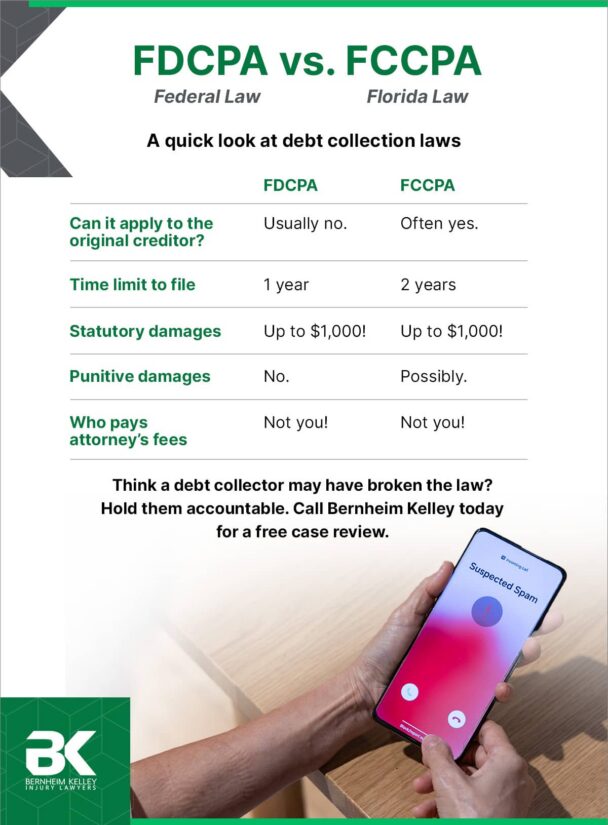
The FCCPA gives Florida consumers stronger debt collection protections than the federal FDCPA in three major ways:
- It can apply to original creditors
- It gives consumers 2 years to file a claim
- It allows punitive damages in some cases
The Federal Law: What the FDCPA Does
The federal Fair Debt Collection Practices Act (FDCPA) has been on the books since 1977. It applies in every state. It sets the rules for what collectors are allowed to do and lists the things they can never do.
Under the FDCPA, a debt collector cannot:
- Call you before 8 a.m. or after 9 p.m. in your time zone
- Call you at work if your employer has told you not to take those calls there
- Use obscene or threatening language
- Call repeatedly with the intent to harass
- Misrepresent the amount you owe
- Threaten to take legal action they don’t actually intend to take
- Pretend to be lawyers or government officials
- Tell other people about your debt
- Keep contacting you after you’ve sent a written request to stop
If they break any of those rules, you can sue them. The federal law allows up to $1,000 in statutory damages per case, plus any actual damages you can prove (15 U.S.C. § 1692k(a)). The collector pays the legal fees if you win. You have 1 year from the date of the violation to file (15 U.S.C. § 1692k(d)).
That’s the federal framework. It’s a real protection, and it does real work. But it has a hole in it.
The Hole in the Federal Law That Florida Fixed
The FDCPA only applies to third-party debt collectors. Not to the original creditors.
Put simply, this means the federal law only covers companies that bought or were hired to collect on someone else’s debt (e.g., the collection agency, debt buyer, law firm acting as a collector). It does not cover the original creditor itself.
So if your credit card company is harassing you directly about a balance you owe them, the FDCPA does almost nothing for you. If your hospital’s billing office is calling you 4 times a day, the FDCPA can’t touch them. If your cable provider’s collections department is threatening to sue you over an unpaid bill, the FDCPA doesn’t apply.
That’s where Florida’s debt collection laws come into play.
What the FCCPA Adds
The Florida Consumer Collection Practices Act (FCCPA) covers everything the FDCPA covers, and then some. It applies to third-party collectors and to original creditors. It applies to debt buyers. It applies to anyone trying to collect a consumer debt in Florida.
That single difference changes everything about how a Florida debt collection harassment case works.
If a collector calls your mother about your debt, the FDCPA gives you a claim against them. The FCCPA gives you a claim against the collector and potentially against the credit card company that hired them. Two defendants. Two paths to recovery. One case.
This is why Florida courts have been described as deliberately consumer-friendly on this issue. The FCCPA was written to be tougher on collectors and creditors than the federal law. Florida courts are statutorily required to read it that way. When a Florida judge has to decide a close call under the FCCPA, the law tells them to lean in favor of the consumer.
Who Does the FCCPA Actually Cover?
The FCCPA covers any “person” who is trying to collect a consumer debt in Florida. That includes:
- Individuals
- Businesses
- Banks
- Hospitals
- Utility companies
- Landlords
- Credit card companies
- Debt collection agencies
- Debt buyers
- Law firms acting in a collection role
It also covers third parties acting on behalf of any of those entities. So if your credit card company hires a collection agency, and that agency hires a vendor to make robocalls, all three potentially fall under the statute.
If you’re being harassed by a company over money you allegedly owe, the FCCPA almost certainly applies.
The Two-Year Statute of Limitations
This one matters more than people realize.
Under the federal FDCPA, you have 1 year from the date of the violation to file a lawsuit (15 U.S.C. § 1692k(d)). After that, you don’t have a case, even if the violation was a clear one.
Under the FCCPA, you have 2 years (Fla. Stat. § 559.77(4)).
That extra year is the difference between having a case and not having one for many Floridians. Most people don’t know they have a claim until well after the calls have stopped. They got their voicemail box back. They blocked the number. They moved on. And then six months later, they find out from a friend that the conduct was illegal.
Under federal law, the clock is already running out. Under Florida law, they still have time. The 2-year window in the FCCPA exists because the legislature understood that consumers don’t always know in the moment that a line has been crossed. The statute is written to give them time to figure it out.
The 19 Things a Collector Can’t Do in Florida
The FCCPA spells out 19 specific prohibited acts. They’re worth knowing because each one can be its own violation.
A collector cannot, under Florida law, do any of the following while trying to collect a consumer debt:
- Threaten you with violence or criminal prosecution.
- Disclose information about your debt to your employer before getting a judgment.
- Disclose information about your debt to anyone who has no legitimate business reason to know it, or knowingly disclose false information that affects your reputation.
- Communicate with you or your family using abusive or obscene language.
- Send you anything that looks like a court document or legal process when it isn’t.
- Pretend to be an attorney or a law enforcement officer.
- Claim to be acting on behalf of a government agency when they aren’t.
- Tell you that nonpayment will result in your arrest, garnishment, or property seizure, when those things either can’t legally happen or aren’t actually being planned.
- Use deceptive forms to collect a debt.
- Try to collect from you when they know they don’t have a legitimate claim to the money.
- Claim or attempt to enforce a debt they know is not legitimate.
- Mail you anything in an envelope with language designed to embarrass you about the debt.
- Communicate with you between 9 p.m. and 8 a.m. in your time zone without your prior consent.
- Communicate with you in any way that harasses, oppresses, or abuses you.
- Use the phone or any device to call you repeatedly with the intent to harass.
- Communicate with you when you’ve told them in writing that you don’t want them to.
- Misrepresent the amount or status of the debt.
- Communicate with you if they know you have an attorney handling the matter and they can reach the attorney.
- Send postcards or use any other open communication that makes the debt visible to third parties.
Most consumers reading that list will see something they’ve experienced (Fla. Stat. § 559.72).
Damages Under the FCCPA
Damages in an FCCPA case can come from three places.
- Actual Damages: If the collector’s conduct cost you money, or caused you provable harm like missed work, mental health treatment, or job loss, you can recover what you actually lost.
- Statutory Damages: Up to $1,000 in additional damages, on top of any actual damages, just for the violations themselves.
- Punitive Damages: This one doesn’t exist under federal law. If the collector’s conduct was bad enough, on purpose, or repeated enough, a Florida court can award punitive damages on top of everything else. These are meant to punish them and discourage other collectors from doing the same thing.
How a court decides the size of a statutory damages award is also written into the law. The judge has to look at three things:
- How serious the conduct was
- How often it occurred
- Whether they did it intentionally
If they called you twice and stopped, that’s in a different category from someone who called you 50 times after you sent a written cease-and-desist letter. The statute tells the court to factor that in.
And the FCCPA, like the FDCPA, requires the collector to pay your attorney’s fees if you win. You don’t pay out of pocket. The defendant does.
Florida Also Requires Debt Collectors to Be Licensed
This is a smaller detail that most states don’t have. Florida requires third-party debt collectors to register with the Office of Financial Regulation and to maintain a license to operate in the state.
This matters in two ways:
- You can ask them for their Florida license number. If they don’t have one or refuse to give it, that itself is a potential violation.
- If they’re operating without proper registration, Florida’s Attorney General has the authority to sue them. The fine for unregistered collection in Florida is $10,000 plus attorney’s fees, paid by the collector.
If you’re being contacted by a collection agency in Florida, you have every right to ask if they’re licensed. And they have every obligation to answer.
How the Two Laws Work Together
Floridians can usually bring claims under both the federal FDCPA and the state FCCPA in the same lawsuit. The two statutes overlap, but they don’t cancel each other out. Where they overlap, you often get to pick the path that recovers the most.
In practice, this means a single bad collection call could give rise to a federal claim against the third-party collector, a Florida claim against that same collector, and a Florida claim against the original creditor who sent them. Three claims. One incident.
Florida courts have been handling these cases for decades. And the volume of FCCPA cases filed each year in Florida shows that the law is doing real work.
Ready To Stop the Harassment?
If a collector or an original creditor in Florida has been harassing you, it’s time to take Real Action. The first step is figuring out what they did. The second step is making it stop.
Our team at Bernheim Kelley handles consumer protection cases across Florida, and we Keep It Real with you from the first call. Your case review is FREE, and if we take your case, the collector or creditor pays our fees, not you!
Reach out online or call 954-329-0440 and tell us what’s been happening. If you have a case under the FCCPA, the FDCPA, or both, we’ll tell you. If you don’t, we’ll tell you that too. Either way, you’ll know.
FREE case review. Zero fees for you. If we win, the company pays our attorneys’ fees!
Did a debt collector–


Try to collect on a time-barred debt?